The real app
These are the actual screens.
Not mockups. Captured from the build that is on the App Store, with the sample profile the app ships with.
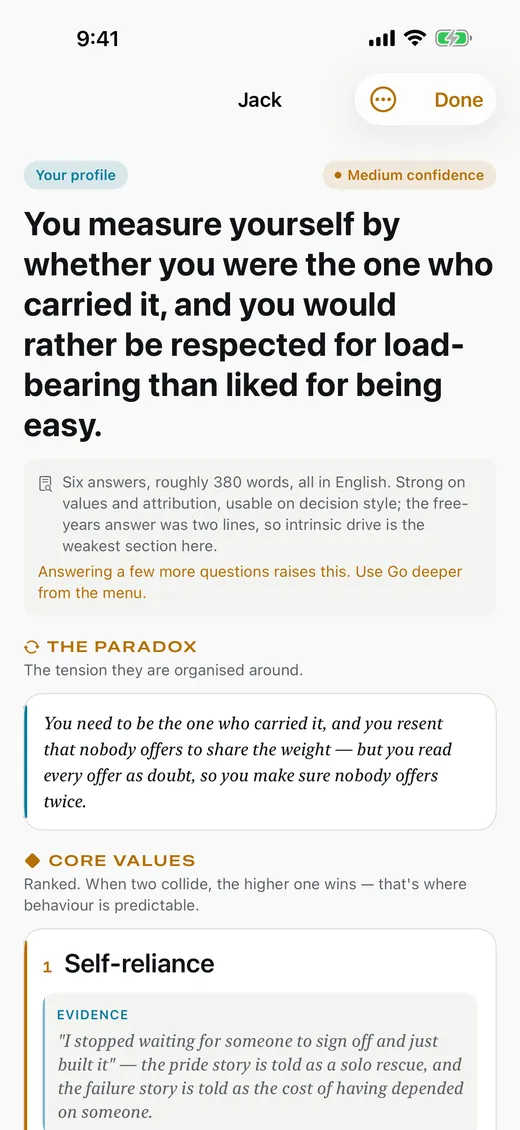
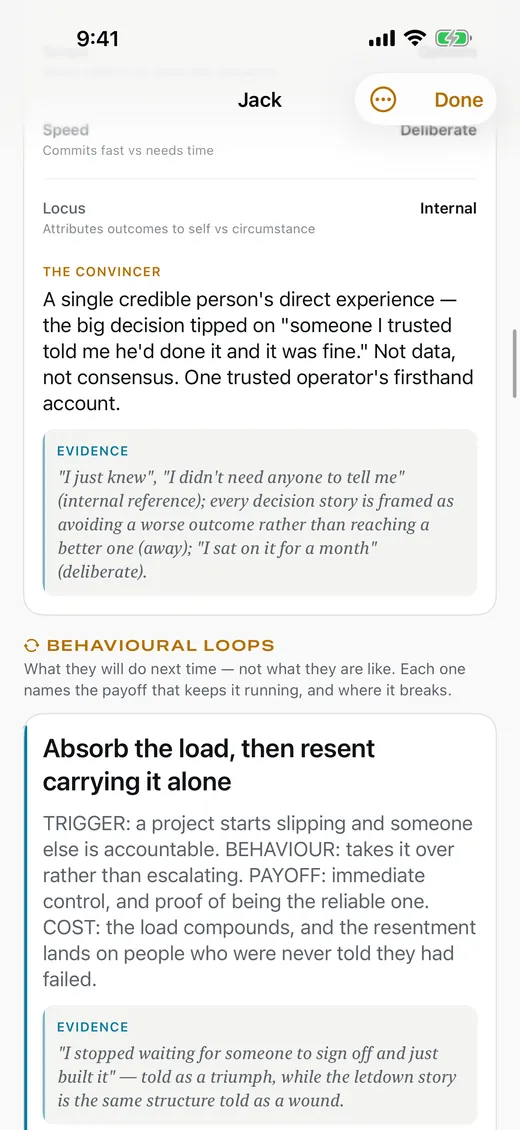
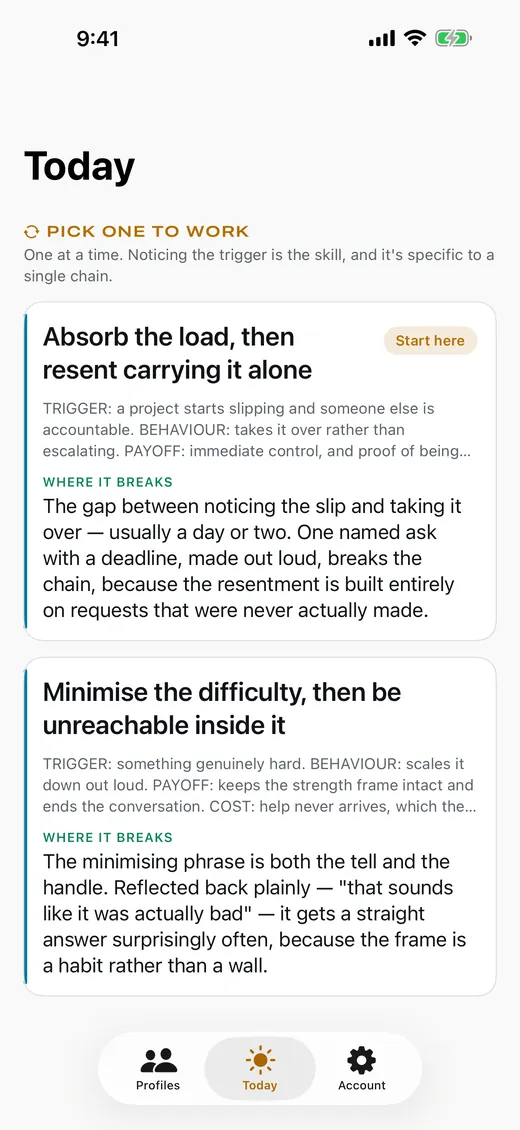
Answer six questions in your own words. Tell finds the values you defend, the need you never name, and the loops you keep running. Every finding carries the line you wrote that proves it, so you can check the work instead of believing it.
Coming to iPhone. Your first profile is free, then three days free on Tell. Not therapy, and not a substitute for care.
Reliability, held as a debt rather than a virtue.
“I'd rather overwork than be seen as someone who didn't do what he said.”
Anchored · Question 4, what people get wrong
You said yes when you meant no, again. You reopened the same finished work for the fourth time. You went quiet instead of asking, and told yourself it was faster. You can name the thing you keep doing — what you cannot name is what it gives you, and that is the part that makes it repeat.
Generic self-improvement assumes a generic person. It tells you to set boundaries without knowing that the boundary is not the hard part for you.
Understanding a pattern and interrupting one are different skills. Most products stop at the first and let you believe you have done the second.
The thing you do automatically is the thing you are least able to describe. It takes something outside your head, reading what you actually wrote.
It is too few for a personality test and far more than a quiz. That is deliberate. These six are chosen so that the answers give away the things people cannot describe about themselves directly.
Tell me about something you're genuinely proud of. What made it meaningful, and what did you have to do that others might not have seen?Even if it wouldn't impress anyone else.
Describe a recent, ordinary moment when someone disappointed or frustrated you. What happened, what did you do next, and what bothered you most?An ordinary one, not the hardest thing you've been through.
Imagine you have two years with enough money, no obligations, and nobody to impress. Walk me through an ordinary Tuesday after the novelty has worn off.Describe the day, not the plan.
Tell me about a recent period when you felt under pressure or uncertain. What did you notice first, what did you do repeatedly, and what gave you temporary relief?An ordinary one, not the hardest thing you've been through.
Walk me through an important decision you made. Which options did you consider, whose input did you seek, what were you afraid of getting wrong, and what finally decided it?The one that was hardest to make, not the one with the biggest number attached.
What pattern in your life keeps repeating even though part of you wants it to change? Describe the last time it happened, what the pattern gives you in the moment, and what it costs later.The last time it happened, not the general shape of it.
The five you actually defend, in order, each with the line you wrote that proves it and a confidence score you can argue with.
The contradiction at the centre of how you operate. Most people recognise theirs immediately and have never had words for it.
How you decide, what you risk, what you need from people, how much you show. Scored, not labelled with a type.
Not adjectives. The particular thing you do well, described precisely enough to use on purpose.
The places your strengths are the cause. This is the part people come back to.
The patterns that run without you choosing them, and the point in each where it can be interrupted.
No sliders and no personality type. You write, in your own words, and everything after that is built from what you said.
Ten to fifteen minutes, typed or spoken. Dictation runs on the phone itself.
The analysis runs on our servers, so you can close the app. It carries on without you.
Values ranked with the line that proves each one, the paradox at the centre of how you operate, and your loops.
One. Not a programme of twelve habits — the single pattern you would most like to catch earlier.
A short check-in, then a ten-minute guided session written that morning for your loop and your goal. It remembers yesterday.
That is why it survives. Tell names each loop you run, and finds the one place in it where the sequence can actually be interrupted, which is almost never the behaviour itself.
The specific situation that starts it. Not "stress" — the meeting, the message, the silence after you ask for something.
What you reliably do next. The part you already know about, and the part that changing never works on directly.
What it genuinely gives you: relief, control, the feeling of being the reliable one. Loops without a payoff die on their own.
What it takes from you over months, and the one point where the sequence is actually interruptible. That is where the daily coaching goes to work.
Six answers are enough to see the shape. They are not enough to be sure of it. The second stage asks ten deeper questions — five quick ones about how you rate yourself, five stories about what you actually did — and then re-reads the first profile against all sixteen answers. Every claim comes back confirmed, narrowed, revised or rejected, with the line that decided it.
A slider says you prefer a plan. Your story about the thing you finished says you started without one. The report puts the two side by side and says which the evidence supports — and treats a gap as information about context, never as a fault.
Each one carries what you did, what it may mean, the words it rests on, the reading that would refute it, and the one question that would settle it. Rejected claims are shown, not hidden: a re-read where nothing moved means the questions were not asked.
A single pattern, the smallest point where it can be interrupted, and something to try that takes under five minutes. What counts as success is written down beforehand, and so is what to do after a missed attempt.
Every question can be declined, and a decline is carried into the report as an answer. The Advanced Profile is one of your plan's deeper reads. It will not tell you whether trauma occurred, what your attachment style is, or anything a diagnosis would — and it says so, in its own words, at the end of every report.
You pick the loop that costs you most. Every day you get a short check-in, then a ten-minute guided session written for that day — a calm, spoken induction that works the loop through relaxation and repetition rather than advice. Included from Tell Plus; one credit each on Tell.
Four turns. It asks about the thing you said you were working on, and it asks about yesterday, because it kept yesterday.
Written that morning for your loop and your goal, not pulled from a library of episodes, and read slowly by a warm, unhurried voice — never your phone's robotic one. Day twenty builds on day nineteen, and every session is kept to play again.
Four weeks of days, coloured by what happened: the trigger appeared and you caught it, it ran, or it never showed up. A quiet day is not a missed one. Every Monday the coach writes last week up from the record — what the check-ins actually showed, and one thing to try next — and keeps the note, so a loop reads back as a series.
A product that reads people has to be clear about where the reading stops. Tell has no other source of information about you, and nowhere else it sends what you write.
Tell does not browse, scrape or search. There is no profile it can build from anything except the words handed to it, and no record of you it assembles in the background.
Your answers are analysed and the report comes back to your device, where it stays. Coaching audio is the one thing kept on a server, and it is deleted after thirty days.
When you speak an answer instead of typing it, the transcription happens on the phone itself. The audio is not uploaded to be turned into text.
Tell describes how you operate and coaches you on one loop at a time. It does not diagnose or treat anything, and it is not a substitute for care from someone qualified to give it.
One subscription covers your profile, your loops, daily coaching with audio, chat, and a number of other people you can read. The tiers differ in that last number and nothing else. Tell starts with a three-day free trial; cancel in Settings before it ends and you are not charged.
after the trial, or $79.99 a year
For working on yourself.
Free for 3 days, then $12.99 a month. Renews until cancelled; cancel any time in Settings. One trial per Apple Account.
or $199.99 a year
For people who read a room for a living.
or $449.99 a year
For therapists, coaches and facilitators, with clients who consent.
Not mockups. Captured from the build that is on the App Store, with the sample profile the app ships with.
You send a link. They answer the questions themselves, in their own words, in their own time — the six, or on Tell Pro all sixteen. What comes back is a structured read of how they operate with every finding quoted from what they wrote, and from the sixteen-question link an Advanced Profile as well: findings with the reading that would refute each, up to three loops with their interruption points, what they say about themselves next to what their stories show, and a change plan sized to how ready they said they were.
Nothing here profiles someone from the outside. The link goes to your client, they choose what to write, and they see who asked before they answer a single question.
A finding you cannot trace is a finding you cannot use. Each one carries the client's own words and a confidence level, and says plainly where the evidence runs out.
It is not an assessment instrument, not a diagnosis, and not a clinical opinion. Tell refuses to infer trauma, health or a diagnosis for a practitioner exactly as it does for anyone else. Your client consenting does not change that.
Structured self-report before a first session, in language you can quote back. It tells you what someone protects, how they decide, and the loops they already know they run. The sixteen-question link adds what they cannot report directly: where their self-rating and their behaviour part company.
About twenty-five minutes for them. Their profile is ready the moment they finish; the Advanced Profile is written in the minutes after and attaches itself to the same record. One collection, one price. Any question they decline is recorded as declined, never guessed at.
Every Advanced Profile ends with a list, in its own words: it cannot determine whether trauma or abuse occurred, it is not a mental-health diagnosis, it cannot determine attachment style, it cannot verify anyone else's motives, and patterns change with context and time.
No, and it does not try to be. Tell describes how you operate and coaches you on one behavioural loop at a time. It does not diagnose, it does not treat, and it is not a substitute for care from a licensed professional. If something in your life needs that kind of help, it needs that kind of help.
They are not enough to describe a person. They are enough to show how one thinks, because the six are chosen so the answers reveal structure rather than facts: what you reach for when you are proud, what stings when you are let down, what you do when nobody is watching. Everything Tell concludes is quoted from what you wrote, so you can judge each finding on its evidence rather than on our word.
Your answers are sent to be analysed and the profile comes back to your phone, where it stays. Coaching audio is the one thing kept on a server, and it is deleted after thirty days. Dictation happens on the device itself. The full detail is in the privacy policy, which is written to be read rather than to be survived.
You can read someone from what they have shared with you, or send them the same six questions to answer themselves. What you cannot do is use it to monitor anyone, to profile a child, or as the basis for a decision about someone's job, housing or credit. Those requests are refused before anything runs.
Your first profile is free, before any subscription, because nobody should pay to find out whether the quality is real. After that, Tell starts with three days free — cancel in Settings before it ends and you are not charged. Every plan states its monthly limits in the app as well as here.
Tell is coming to iPhone. Your first profile is free.